Semuliki National Park protects one of Uganda’s most distinctive natural landscapes: a lowland tropical forest with strong ecological connections to the great forests of the Congo Basin. Situated on the floor of the Albertine Rift Valley in western Uganda, the park offers an experience that feels markedly different from the country’s savannah parks and high-altitude mountain forests.
Covering approximately 220 square kilometres, Semuliki represents the easternmost extension of the vast Ituri Forest ecosystem. Its low elevation, humid climate, dense forest, swampy clearings, palm-lined river landscapes and remarkable biodiversity give visitors a fascinating glimpse of Central African forest ecology without leaving Uganda.
The park is particularly celebrated for its extraordinary birdlife, geothermal Sempaya Hot Springs, butterflies, primates and specialist forest wildlife. For dedicated birdwatchers and naturalists, Semuliki is one of Uganda’s most rewarding destinations.
Uganda’s Lowland Tropical Forest
Semuliki is widely recognised as East Africa’s outstanding example of true lowland tropical forest.
The park lies at an altitude of approximately 670 to 760 metres above sea level on the floor of the Albertine Rift Valley. Its vegetation is dominated by moist evergreen and semi-deciduous forest, with swamp forests and other specialised habitats occurring throughout the landscape.
Much of the plant and animal life shows stronger similarities with the Congo Basin than with the better-known East African savannah ecosystems.
This relationship with Central Africa is what makes Semuliki so unusual. Travellers who have already experienced Uganda’s gorilla forests, open grasslands and mountain landscapes discover an entirely different ecological world here.
A Gateway to the Congo Basin
The Semuliki River winds through the western side of the landscape and forms part of Uganda’s international boundary with the Democratic Republic of the Congo.
Its meandering channels, riverine vegetation and surrounding lowland forest reinforce the park’s close ecological relationship with Central Africa.
Numerous plant, bird and mammal species associated with the Guinea-Congo forest region reach the eastern limits of their ranges around Semuliki, giving the park exceptional conservation importance.
For naturalists, the result is a destination where the wildlife community can feel noticeably different from other protected areas in Uganda.
A True Birder’s Haven
Birdwatching is one of the greatest reasons to visit Semuliki National Park.
Uganda Wildlife Authority records approximately 441 bird species within the park, including many specialist forest birds and species associated with the Guinea-Congo biome. Several species found here are extremely difficult or impossible to encounter elsewhere in East Africa.
Birding can begin directly along the roads and forest edges, where clearings provide opportunities to scan the canopy, before continuing onto specialised forest trails.
The famous Kirumia Trail passes deep through different forest habitats towards the Semuliki River and is regarded as one of the park’s most rewarding routes for serious birdwatchers.
Among the many sought-after species associated with Semuliki are the Congo serpent eagle, Nkulengu rail, black dwarf hornbill, Gabon woodpecker, capuchin babbler and other Central African forest specialists.
For birders building a comprehensive Uganda checklist, Semuliki can become one of the most important stops on the entire safari.
The Sempaya Hot Springs
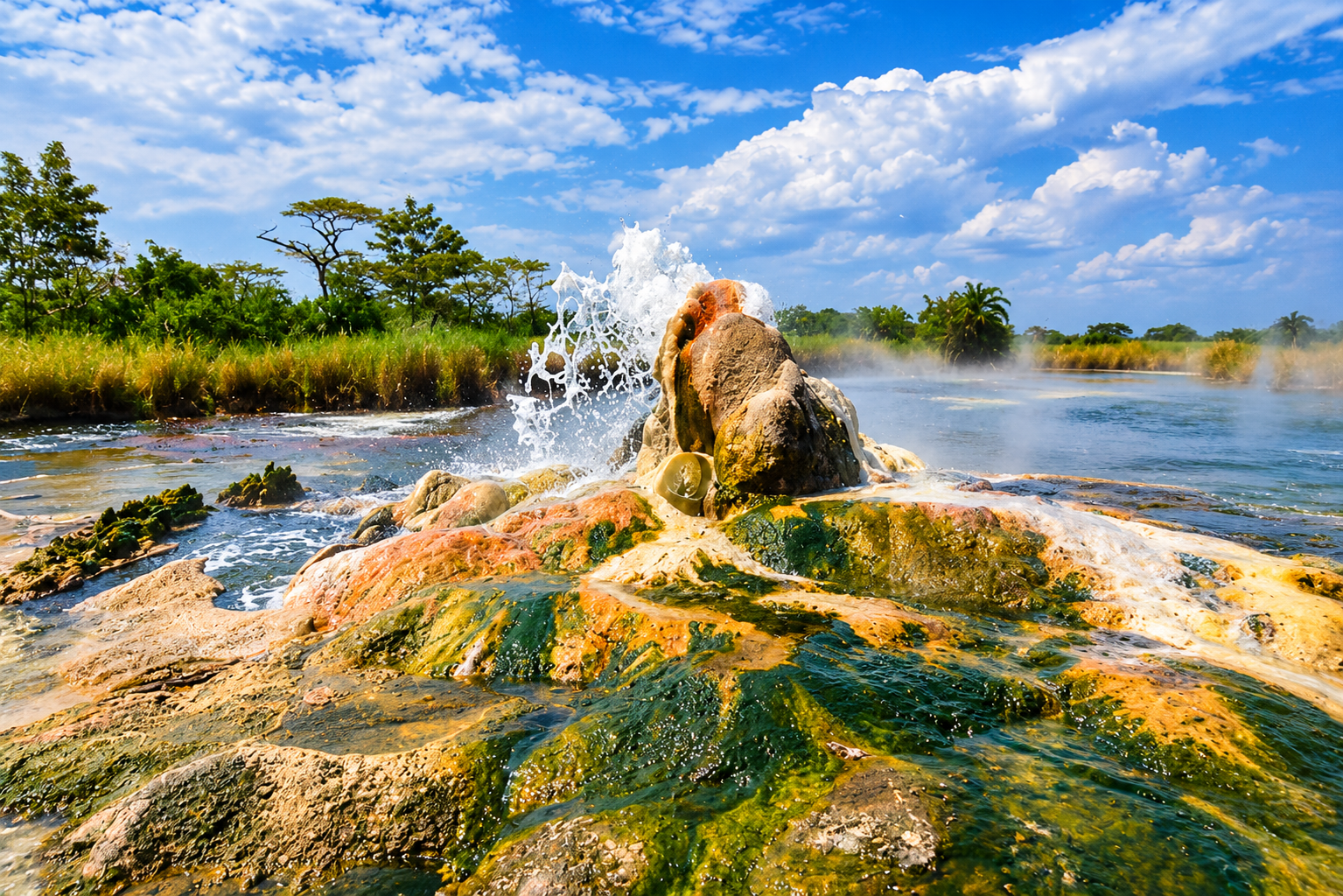
The Sempaya Hot Springs are the park’s most famous geological attraction and one of the most unusual natural sights in western Uganda.
Two principal springs are traditionally identified as the male and female springs.
The female spring, commonly known as Nyasimbi, is particularly dramatic. Boiling water and steam emerge from underground, creating an impressive geothermal spectacle surrounded by tropical vegetation.
The male spring, Bintente, lies farther along a forest trail and is characterised by a broad steaming pool set within a swampy clearing.
Boardwalks and forest trails allow visitors to explore the springs while also discovering birds, plants, butterflies and primates along the way.
The geothermal activity provides a visible reminder that Semuliki lies within the tectonically active Albertine Rift.
Primates and Forest Wildlife
Although Semuliki is best known for birds rather than traditional big-game viewing, the forest supports an impressive variety of mammals.
Uganda Wildlife Authority records more than 50 mammal species within the park, including primates and several animals associated with Central African forests.
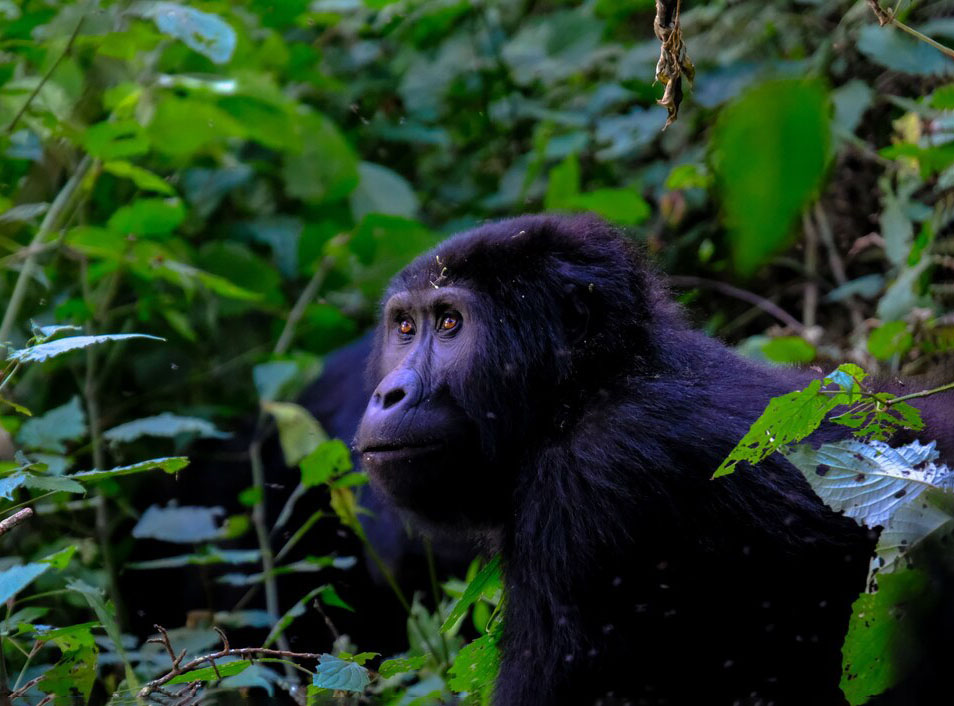
Primates include species such as chimpanzees, baboons, red-tailed monkeys, black-and-white colobus and specialised monkeys associated with the western forests.
Other mammals recorded from the wider forest ecosystem include forest buffalo, elephants, leopard, duikers and the water chevrotain.
Wildlife sightings in dense rainforest are naturally less predictable than in open savannah. This is part of Semuliki’s character: visitors explore slowly, listening for calls and watching carefully for movement among trees, vines and undergrowth.
Butterflies and Forest Insects
Semuliki’s biodiversity extends far beyond birds and mammals.
The park supports hundreds of butterfly species as well as an exceptional variety of moths and other insects.
Colourful butterflies are frequently encountered around forest clearings, trails, streams and sunlit openings, adding another dimension to guided nature walks.
For photographers, researchers and travellers interested in smaller forms of wildlife, Semuliki can be every bit as fascinating as Uganda’s larger wildlife destinations.
Forest Trails and Nature Walks
Exploring Semuliki on foot allows visitors to experience the rainforest at its own pace.
Guided trails pass through different forest habitats where visitors can observe trees, butterflies, primates and forest birds while learning about the ecological relationships that support the rainforest.
Shorter walks are available around Sempaya, while longer routes such as the Kirumia Trail provide a deeper wilderness experience.
Night walks may also reveal a completely different side of the forest as nocturnal primates, insects, frogs and other wildlife become active after sunset.
Because rainfall can occur throughout the year, forest walks should always be approached with suitable footwear and lightweight rain protection.
The Kirumia Trail
The Kirumia Trail is one of Semuliki’s most important specialist birding and forest routes.
The trail extends for approximately 14 kilometres through a variety of habitats towards the Semuliki River, passing through mature forest, secondary vegetation, swampy areas and other important bird habitats.
It provides opportunities to search for several of the park’s rare and restricted-range forest species while also experiencing the extraordinary atmosphere of the lowland rainforest.
Although sections can be explored during a day excursion, longer arrangements may offer serious birders more time to appreciate the diversity of the route.
Communities Around Semuliki
Several communities have longstanding cultural and economic relationships with the landscapes surrounding Semuliki.
These include Bwamba farming communities around the lower mountain areas, Bakonjo communities associated with the Rwenzori slopes, Batuku pastoral communities and Batwa communities with historical connections to forest environments.
Well-managed cultural experiences can introduce travellers to traditional livelihoods, stories, food, crafts, music and community conservation initiatives.
Cultural encounters should be approached respectfully, with local people presented as contemporary communities rather than simply as tourist attractions.
Conservation Importance
Semuliki Forest was protected as a forest reserve in 1932 and became a national park in 1993.
Today the park conserves an ecosystem that has extraordinary importance because of its connection to the Congo Basin and its position at the meeting point of different climatic and biological regions.
Its forests protect specialist birds, primates, mammals, butterflies, plants and wetland habitats while also supporting ecological services for surrounding communities.
Conservation challenges include pressure on natural resources, habitat disturbance and increasing demand for land and forest products around protected areas.
Community participation and responsible tourism therefore play an important role in the long-term protection of the park.
Main Attractions
01
Sempaya Hot Springs. Semuliki's most famous attraction is the spectacular Sempaya geothermal area, where boiling water, steam and bubbling pools emerge from beneath the Rift Valley floor. The springs combine geological interest with a beautiful rainforest setting.
02
Nyasimbi Female Hot Spring. Nyasimbi is the dramatic female hot spring at Sempaya. Boiling water and steam rise from underground among surrounding forest vegetation, creating one of the park's most memorable natural spectacles.
03
Bintente Male Hot Spring. The male spring, Bintente, lies farther along a forest trail and boardwalk. Its broad steaming pool sits within a swampy forest clearing and provides a very different experience from the more dramatic female spring.
04
Ituri Forest Ecosystem. Semuliki represents the eastern extension of the great Ituri Forest of the Congo Basin. Its lowland rainforest supports plants and animals with strong Central African affinities and gives the park a character unlike most other Ugandan protected areas.
05
Semuliki River. The winding Semuliki River forms part of Uganda's international boundary with the Democratic Republic of the Congo. Its riverine habitats, meandering channels and surrounding forest contribute to the park's distinctive Congo Basin atmosphere.
06
Guinea-Congo Forest Birds. Semuliki is internationally important for bird species associated with the Guinea-Congo forest biome. Many of these specialist birds reach the eastern limits of their African ranges here.
07
Rare Forest Birdlife. With approximately 441 recorded bird species, Semuliki is one of Uganda's outstanding birding destinations. Specialist species include hornbills, forest raptors, rails, woodpeckers, greenbuls and other birds difficult to find elsewhere in East Africa.
08
Kirumia Trail. The approximately 14-kilometre Kirumia Trail passes through diverse forest habitats towards the Semuliki River. It is one of the park's premier birding routes and an excellent way to experience deeper sections of the rainforest.
09
Forest Primates. The park supports a variety of primates, including chimpanzees, baboons, colobus monkeys and other forest monkey species. Encounters are unpredictable in the dense vegetation, making every sighting rewarding.
10
Butterflies and Moths. Semuliki supports exceptional butterfly and moth diversity. Forest edges, clearings and trails can reveal colourful species that make the park particularly interesting for naturalists and macro photographers.
11
Albertine Rift Valley Scenery. The dramatic descent from the Fort Portal highlands into the Semuliki Valley provides impressive views across the Albertine Rift, with the Rwenzori Mountains rising above the surrounding lowlands.
12
Community and Cultural Heritage. Bwamba, Bakonjo, Batuku and Batwa communities live around the wider Semuliki landscape. Respectfully organised community experiences introduce visitors to local traditions, livelihoods, crafts and relationships with the surrounding environment.
Things To Do
01
Specialist Birdwatching. Explore one of Uganda's most important birding destinations in search of Guinea-Congo forest specialists, forest raptors, hornbills, greenbuls and other rare species associated with the Central African forest biome.
02
Kirumia Trail Birding. Walk sections of the famous Kirumia Trail with an experienced guide. The route passes through several forest habitats and is particularly rewarding for serious birders searching for Semuliki's specialist species.
03
Sempaya Hot Springs Walk. Follow the forest trails and boardwalks around Sempaya to experience the male and female hot springs while also observing tropical vegetation, butterflies and forest birds.
04
Guided Forest Nature Walks. Explore Semuliki's rainforest with a ranger guide who can interpret the forest's plants, birds, primates, insects and ecological relationships.
05
Primate Watching. Search the forest for monkeys, baboons and other primates while walking quietly through the park's trails and forest-edge habitats.
06
Forest Bird Photography. Photograph specialist forest birds in one of Uganda's richest ornithological destinations. Patience, a telephoto lens and an experienced birding guide can greatly improve photographic opportunities.
07
Butterfly Watching. Explore sunny forest openings, trails and riverine areas in search of Semuliki's remarkable variety of butterflies and other insects.
08
Nature Photography. Capture steaming hot springs, lowland rainforest, butterflies, unusual vegetation, forest wildlife and the dramatic scenery of the Albertine Rift Valley.
09
Night Forest Walks. Where available and arranged with authorised guides, night walks provide opportunities to experience the forest after dark and search for nocturnal primates, insects, frogs and other nighttime wildlife.
10
Forest Ecology Exploration. Learn about the relationship between Semuliki and the Congo Basin, the transition between Central and East African ecosystems and the specialised plants and animals that occur within this remarkable lowland forest.
11
Cultural and Community Experiences. Visit communities around the park through responsibly organised programmes and learn about local livelihoods, food, crafts, music, traditions and conservation initiatives.
12
Combined Western Uganda Safari. Combine Semuliki with nearby destinations such as Kibale Forest National Park, Rwenzori Mountains National Park, Toro Semliki Wildlife Reserve and Queen Elizabeth National Park for a diverse western Uganda itinerary.
 white-water rafting & adventure safari