There is a moment, somewhere between the noise of Kampala and the quiet of the countryside, when Uganda begins to reveal a different side of itself.
It might happen over a plate of freshly prepared matooke. It might happen while walking through a market in Kampala, where traders call out to customers and baskets of fruit sit beside piles of colourful fabrics. It might happen inside a royal tomb, beneath a vast roof of reeds and thatch, where generations of history are still part of living tradition or perhaps it happens in conversation.
A guide explains why a particular hill matters. An artisan describes how a basket is made. A grandmother tells a story she learned as a child. A cook explains why bananas are steamed in a particular way. A visitor listens, asks questions and suddenly realises that the country they thought they had come to see is much more complex than the photographs suggested.
This is the cultural Uganda.
Uganda is famous for its mountain gorillas, chimpanzees, elephants, the River Nile and extraordinary landscapes. But the country has another remarkable inheritance: a living cultural landscape shaped by kingdoms, communities, faiths, languages, craftsmanship, food, music, memory and oral tradition.
And unlike a museum piece sealed behind glass, much of this heritage is still lived.
A Country With Many Histories
It is difficult to talk about “Ugandan culture” as though it were one single tradition.
Uganda is home to many different communities, each with its own language, history, customs, music, cuisine, architecture and social traditions.
The Baganda of central Uganda have the historic Kingdom of Buganda. The Banyankole and Bakiga have shaped the cultural traditions of the southwest. The Basoga are closely associated with the lands around the Nile and Lake Victoria. The Bagisu of eastern Uganda have distinctive traditions surrounding community and initiation. In the north, the Acholi, Lango and other communities have their own histories, music and social traditions, while in Karamoja, pastoral traditions remain an important part of cultural identity.
This diversity is one of the first things a traveller begins to notice when travelling across Uganda.
The language changes.
The food changes.
The landscape changes.
The stories change.
And yet there are familiar threads running through everyday life: family, community, hospitality, respect for elders, music, food and storytelling.
Uganda’s cultural richness is therefore not something confined to a single historic site. It is spread across the country and embedded in ordinary life.
Buganda: A Kingdom That Still Lives
For anyone beginning a cultural journey in Kampala, understanding Buganda is almost unavoidable.
The Kingdom of Buganda has played a major role in the history of the region, and its cultural institution remains significant today.
The Kabaka, the traditional king of Buganda, is at the centre of this institution. Around Kampala and central Uganda, royal sites provide an opportunity to understand the kingdom’s history, architecture and traditions.
One of the most extraordinary of these places is Kasubi.
Kasubi Tombs: Where Architecture Becomes History
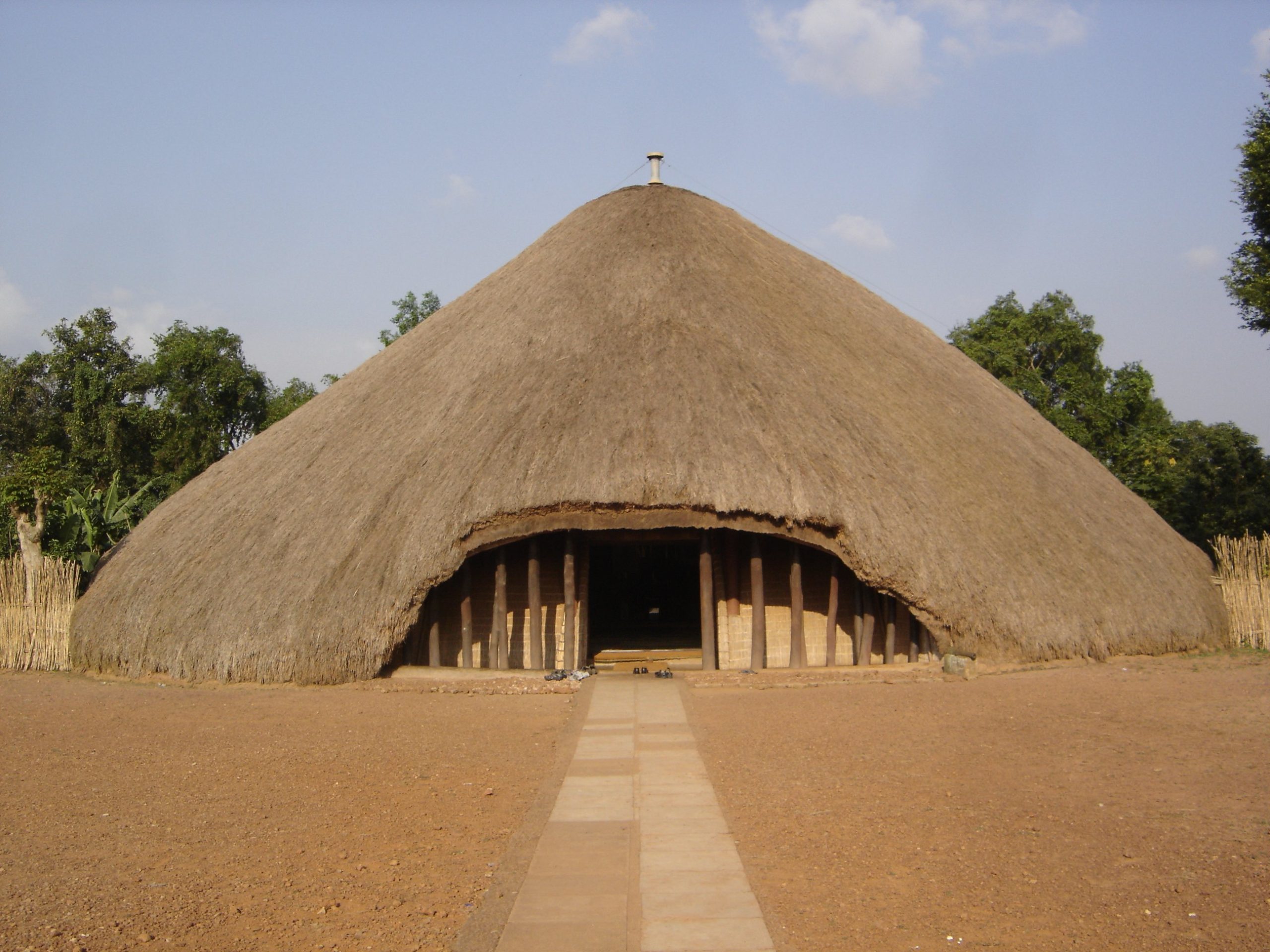
On a hillside in Kampala stands one of Uganda’s most important cultural landmarks: the Tombs of the Buganda Kings at Kasubi.
The present main structure, known as the Muzibu Azaala Mpanga, was built in 1882 as the palace of Kabaka Muteesa I. When Muteesa I died in 1884, the palace became his burial place. Three of his successors were later buried there, making the building the resting place of four Buganda kings.
The building is remarkable not simply because of its age.
It is remarkable because of how it was made.
Wooden poles, reeds, thatch, bark cloth and other organic materials were brought together to create a vast circular structure. The architectural knowledge required to construct and maintain such a building was developed over generations.
Kasubi is also much more than an historic building.
UNESCO describes it as a major spiritual centre for the Baganda and a place where traditional practices continue to be preserved. The entire site covers about 26.8 hectares, including agricultural land managed using traditional methods.
In 2001, Kasubi was inscribed on the UNESCO World Heritage List for its architectural, historical and cultural significance.
The site suffered a devastating fire on 16 March 2010, destroying much of the main structure. Reconstruction followed with support from Uganda, UNESCO and international partners, with particular emphasis on preserving traditional construction knowledge.
That history makes a visit especially poignant.
You are not simply looking at an old palace.
You are standing inside a place where architecture, spirituality, kingship and memory have remained intertwined for generations.
Wamala Tombs: A Quieter Royal Story
Kasubi is perhaps the best-known royal tomb complex, but it is not the only one.
The Wamala Tombs, in Wakiso District, are associated with Kabaka Suuna II, who ruled Buganda from 1832 to 1856. The Metropolitan Museum of Art describes Wamala as the palace and eventual burial place of Suuna II, the 34th Kabaka of Buganda.
According to the Buganda Kingdom, Wamala is especially notable because Suuna II is believed to have been buried with his regalia and alongside the memory of his extensive royal household.
The site offers a different atmosphere from Kasubi.
It feels quieter.
More intimate.
And for travellers interested in understanding the continuity of Buganda’s royal traditions, it provides another important piece of the story.
Uganda’s Ministry of Tourism, Wildlife and Antiquities lists Wamala among the country’s recognised cultural sites and monuments.
Mengo and the Changing Face of Buganda
The story of Buganda is not only about ancient traditions.
It is also tied to Uganda’s modern political history.
Mengo Palace, commonly known as Lubiri, was built in 1922 and became the residence of Kabaka Muteesa II. In 1966, during the political crisis that brought the central government into direct conflict with the Buganda Kingdom, government forces attacked the palace and Muteesa II was forced into exile.
For a visitor, this history gives Mengo a significance beyond architecture.
The palace stands at the intersection of traditional authority and modern Ugandan history a reminder that the country’s cultural institutions have not existed separately from the political events that shaped modern Uganda.
This is one of the things that makes cultural travel so rewarding.
The past is not always safely separated from the present.
Sometimes, it is standing right in front of you.
The Uganda National Museum: A Country Under One Roof
If you want to understand Uganda before travelling around it, the Uganda National Museum in Kampala is an excellent place to begin.
Its story goes back to 1908, when the first Uganda Museum opened in a single room within Captain Lugard’s Fort at Old Kampala. The museum’s collections grew over the following decades, eventually moving to its present Kira Road location, whose permanent building was completed in 1953 and opened in 1954.
Today, the museum’s collections cover archaeology, ethnography, palaeontology, natural history, musical instruments, science and other aspects of Uganda’s heritage.
The national museum says it holds more than 200,000 artefacts, specimens and archival records.
That number is impressive, but the real value of the museum is what those objects represent.
Traditional musical instruments.
Tools.
Household objects.
Clothing.
Archaeological material.
Objects connected to different communities and periods of Uganda’s history.
A visit helps answer questions that a safari itinerary rarely has time to address.
How did people live before modern cities?
What did they eat?
What did they use to work the land?
How did communities make music?
How were objects crafted?
What did earlier generations leave behind?
The museum gives you the beginning of the conversation.
The journey outside Kampala allows you to continue it.
Nyero: Uganda’s Ancient Rock Art
Travel east and the cultural story becomes much older.
Near Kumi in eastern Uganda are the Nyero Rock Paintings, a series of rock shelters containing geometric paintings whose origins remain the subject of archaeological research.
The sites form part of Uganda’s cultural heritage inventory and are listed on UNESCO’s Tentative List.
UNESCO research places the wider tradition of geometric rock art in this region within a period extending roughly 1,000 to 5,000 years ago, although the precise authorship and meaning of individual paintings cannot always be established.
That uncertainty is part of what makes the experience fascinating.
You are looking at images created long before written records could tell us exactly who made them or why.
The paintings include geometric forms and other motifs on granite rock shelters. Some of the sites also retain spiritual significance for local communities today.
Nyero reminds us that Uganda’s cultural history did not begin with kingdoms or colonial records.
It stretches much further back.
Bigo bya Mugenyi and Uganda’s Archaeological Landscape
Uganda’s cultural heritage also includes ancient earthworks.
In western Uganda, Bigo bya Mugenyi is associated with large archaeological earthworks traditionally connected with the Cwezi cultural tradition. The site is included on Uganda’s UNESCO Tentative List and is recognised by the national heritage authorities.
Places such as Bigo are particularly interesting because they challenge the idea that Uganda’s heritage is primarily made up of buildings.
Sometimes heritage is a landscape.
A ditch.
An earthwork.
A mound.
A pattern in the ground.
Something whose purpose may only become clearer when considered alongside oral traditions, archaeology and the surrounding landscape.
For a traveller interested in history, these sites offer a glimpse into Uganda’s deeper archaeological past.
Namugongo: Faith, Memory and the Uganda Martyrs
Culture in Uganda cannot be understood without acknowledging the importance of religion.
Christianity, Islam and indigenous traditions have all played significant roles in shaping the country’s history and contemporary life.
One of the most important religious heritage sites is Namugongo, associated with the Uganda Martyrs.
In the 1880s, a group of Christian converts and followers were executed during the reign of Kabaka Mwanga II. Their deaths became an important part of Uganda’s Christian history.
The Catholic shrine at Namugongo was developed much later.
Land at the site was acquired in 1935, and a parish was established there. In 1967, Archbishop Emmanuel Cardinal Nsubuga began the project to build the monumental shrine that stands today. Construction continued until 1975, when the shrine was officially opened.
The architecture was deliberately inspired by the form of a traditional African hut, with 22 copper pillars representing the 22 Catholic martyrs commemorated at the shrine.
Today, Namugongo is both a place of pilgrimage and an important part of Uganda’s cultural landscape.
Every year, 3 June — Uganda Martyrs’ Day — brings pilgrims from Uganda and beyond.
It is a powerful example of how a historical event can become part of a living tradition.
The Bahá’í Temple: Another Chapter of Uganda’s Religious Heritage
Not far from the centre of Kampala, on Kikaya Hill, stands another remarkable landmark: the Bahá’í House of Worship.
Its foundation stone was laid in 1958, and the building was officially opened in January 1961. It became the first Bahá’í House of Worship on the African continent.
The temple is distinctive for its nine-sided design and its setting within extensive gardens. Kampala’s tourism authorities describe the site as occupying about 52 acres.
What makes the place especially interesting culturally is the story it tells about Uganda’s religious diversity.
Uganda’s heritage is not one religious tradition replacing another.
It is a layered history in which different faiths, communities and institutions have become part of the country’s modern identity.
The Bahá’í Temple is one expression of that story.
Food: Where Culture Becomes Personal
You can read about a culture for hours.
Then someone puts a plate of food in front of you, and suddenly the subject becomes much easier to understand.
Ugandan cuisine is varied, regional and closely connected to everyday life.
Matooke, made from green cooking bananas, is one of the country’s best-known staples. It is commonly steamed and served with dishes such as groundnut sauce, beans, meat, fish or vegetables.
Cassava, sweet potatoes, posho, rice, fresh fish, vegetables and tropical fruits also feature prominently in Ugandan meals.
But the most interesting part is often not the food itself.
It is the preparation.
It is watching someone peel bananas, prepare a sauce, arrange food for a family meal or explain which ingredients came from the market that morning.
A cooking experience can therefore tell you something that a restaurant menu cannot.
It can show you how food fits into family life.
How knowledge is passed from one generation to another.
How ingredients are used.
And how hospitality works.
Markets Are Cultural Spaces Too
A market may not look like a heritage site.
There may be no plaque.
No entrance gate.
No official guidebook.
But markets are among the best places to understand everyday Uganda.
In Kampala, markets bring together traders, farmers, cooks, craftspeople and customers from different backgrounds.
The experience can be noisy and energetic, but it is also incredibly revealing.
Look at what people buy.
Listen to the languages being spoken.
Notice how food is displayed.
Watch how traders negotiate.
Ask about an unfamiliar fruit.
Taste something new.
Talk to a craftsperson.
This is culture without a glass case.
And for many travellers, it is one of the most memorable ways to experience Uganda.
The Craftsmanship Behind the Souvenir
Ugandan crafts are another doorway into cultural life.
Baskets, mats, pottery, jewellery, textiles, wood carvings and other handmade products reflect techniques that have been developed and passed between generations.
A woven basket, for example, may look simple when sitting on a shop shelf.
Spend time with the person who made it, however, and it becomes something else.
You begin to notice the materials.
The pattern.
The time involved.
The skill.
The decisions behind the design.
That is why buying directly from artisans or community-based initiatives can be more meaningful than purchasing a generic souvenir.
You are not simply taking something home.
You are taking home a small piece of someone’s work and story.
Music, Dance and the Sound of Community
Music has always been an important part of social life in Uganda.
Traditional drums, stringed instruments, xylophones and other instruments form part of the musical heritage of different communities.
Dance accompanies celebrations, ceremonies and other social occasions, with different communities developing distinctive rhythms and movements.
Music can also be a way of remembering.
A song may preserve a story.
A rhythm may belong to a particular community.
A dance may mark an important occasion.
For travellers, the best cultural encounters are therefore those that provide context.
Who performs the dance?
When is it traditionally performed?
What does it mean?
Which instruments are being used?
Once you understand the story, the performance becomes much more than entertainment.
Storytelling: Uganda’s Living Archive
Some of Uganda’s most important cultural knowledge was never written down.
It was remembered.
It was spoken.
It was repeated around fires, in homes, at gatherings and between generations.
Storytelling has traditionally been an important way of transmitting knowledge, values, history and identity.
This is why a local guide can be so valuable.
A guide may tell you something about a landmark that you would never discover simply by taking a photograph.
A hill can have a story.
A tree can have a memory.
A royal site can have generations of meaning behind it.
A market can have its own history.
The story gives the place depth.
Uganda’s Culture Is Not Frozen in the Past
Perhaps the biggest mistake a visitor can make is to think of culture as something that belongs only to the past.
Uganda’s cultural traditions are not museum exhibits.
They continue to change.
Young Ugandans listen to traditional music alongside contemporary Afrobeat. Modern restaurants reinterpret local ingredients. Craftspeople combine traditional techniques with new designs. Historic kingdoms continue to maintain cultural institutions while their communities live fully in the modern world.
This is what makes Uganda interesting.
Tradition and modernity are not always opposites.
They often exist side by side.
A young woman can run a modern business while preparing a traditional dish she learned from her grandmother.
A musician can combine contemporary sounds with traditional instruments.
A city neighbourhood can contain a century-old cultural institution beside a modern café.
That is living culture.
Why Local Guides Matter
There is a limit to what a guidebook can tell you.
It can give you dates.
Names.
Directions.
Historical facts.
But it cannot always tell you what a place means to the person standing beside you.
This is where local guiding becomes particularly valuable.
A local guide can explain the significance of a cultural site in everyday language. They can introduce you to local food, help you navigate a market, explain customs and share stories that give a destination personality.
And a female-led cultural experience can offer another perspective particularly when exploring food, markets, family life, crafts and the everyday experiences of Ugandan women.
For travellers who want to move beyond sightseeing, this human connection can be the difference between simply visiting Uganda and actually experiencing it.
A Culture Worth Travelling Slowly For
There is a temptation in modern travel to measure a journey by the number of places visited.
Three national parks.
Four lodges.
Two cities.
Ten attractions.
But cultural travel works differently.
Sometimes the best memory comes from spending an hour in one place rather than rushing through five.
Sitting down for lunch.
Listening to a story.
Watching an artisan work.
Walking through a market.
Talking to a guide.
Learning why a particular dish matters.
Standing quietly inside an old royal tomb.
These moments may not always look dramatic on an itinerary.
They can, however, become the moments you remember years later.
Beyond the Big Five
Uganda’s wildlife will always be one of the country’s great attractions.
But the country’s identity is larger than its wildlife.
The mountain gorillas are extraordinary.
The chimpanzees are unforgettable.
The savannahs are beautiful.
The Nile is immense.
Yet Uganda’s deeper character is found in the spaces between those headline experiences.
It is in Kampala’s streets.
In the royal history of Buganda.
In the ancient paintings at Nyero.
In the collections of the Uganda National Museum.
In the earthworks of western Uganda.
In the pilgrimage at Namugongo.
In the quiet gardens of the Bahá’í Temple.
In the food served at a family table.
In the hands of an artisan.
In the stories shared by a local guide.
These are the details that give the Pearl of Africa its personality.
The Heart of the Pearl of Africa
Uganda does not have a single cultural story.
It has thousands.
Some are written in archives.
Some are preserved in museums.
Some are carved into historic landscapes.
Some are carried through royal institutions.
Some are painted onto ancient rock.
And many still live in people’s homes, kitchens, markets, workshops and conversations.
That is what makes cultural travel in Uganda so rewarding.
You do not have to travel far to encounter history.
You simply have to slow down enough to notice it.
Come for the wildlife, and you may find yourself staying for the stories.
Come for the landscapes, and you may remember the people.
Come expecting a safari, and discover a country with a much deeper identity.
Uganda is not simply a destination to see. It is a culture to listen to, a history to explore and a people to meet.
And perhaps that is the real meaning of travelling through the Pearl of Africa: not merely returning home with photographs, but leaving with a better understanding of the place — and a few stories that belong to it.